Revenue is already in your accounts.

White space analysis is how you find it.

Definition

What is white space analysis?

White space analysis is the structured practice of identifying revenue opportunities that exist inside accounts you've already won. Within any enterprise customer, there are products you haven't sold them, business units you haven't reached, geographies you haven't entered, and buying centers that don't yet know you. The "white space" is the unsold area on the map of an account — the cells where your footprint is zero or thin, but where logical adjacency tells you the customer could plausibly buy.

Done well, white space analysis turns expansion from opportunism into a discipline. The work is dull on the surface — building a matrix, marking cells, talking to internal stakeholders — but the output is a prioritized expansion pipeline that doesn't depend on which seller happens to remember which contact at which subsidiary.

You'll see "white space" written as one word ("whitespace"), two words, or hyphenated ("white-space"). They all mean the same thing. The two-word form is more common in enterprise sales literature and is the canonical form in this guide; the one-word form appears more often in product and marketing contexts.

Why now

Why white space matters in enterprise accounts

Three forces have made white space analysis more important, not less, over the last decade.

Buying centers shift faster than CRM data

Enterprise customers reorganize. Departments split. Centers of excellence get spun up. A buying center that didn't exist in your Salesforce account two years ago is now the owner of a $5M decision. White space analysis is the act of catching up to where the customer actually is, on a regular cadence, rather than relying on the contact records you accumulated when you first won the deal.

The cost of acquiring a new logo keeps climbing

Enterprise customer-acquisition cost has been compounding for years. The math has shifted toward expanding existing accounts before chasing new ones — but only if you can see the expansion opportunities. White space analysis is what turns "expand existing accounts" from a slogan into something an account team can actually run.

Buying committees expect proactive selling

Enterprise buyers increasingly expect their account teams to know the account better than they do — to walk in with "we noticed your APAC business is on Product A but not Product B; here's what comparable accounts saw" instead of "what are your priorities this year?" White space gives you the structure to walk into that conversation.

The team that wins the expansion isn't the team with the most charismatic seller. It's the team where everyone — KAM, AE, customer success, sales engineer — can see the same picture of the account, and where one person leaving doesn't reset the picture to zero.

The matrix

The white space matrix: how to map it

White space analysis runs on a matrix. The matrix has two axes — what you sell, and where you sell it.

The columns are usually products or services

Pulled from your product hierarchy, grouped by line of business, and limited to the products that are commercially relevant to this account. Don't include every SKU; group at a level where each column represents a meaningful buying decision (e.g., "Workflow Automation Suite" rather than each individual SKU within it).

The rows are configurable per account

This is where teams often get stuck — there's no single "correct" choice. Pick whichever row dimension actually maps to how the customer makes decisions:

For a global industrial services company with strong regional P&Ls, regions are the right rows. For a holding company with ten operating businesses, business units win. For a centralized customer, personas. Pick once per account, then revisit annually.

Each cell is a buying decision

Where a row meets a column — say, "Workflow Automation Suite × EMEA" — you're asking: does this part of the customer use this product? Is there revenue in that cell? Is it growing, stable, declining, or zero?

The matrix below — taken from ARPEDIO's white-space view inside Salesforce — shows that exact treatment: products across regions, with each cell color-coded by state.
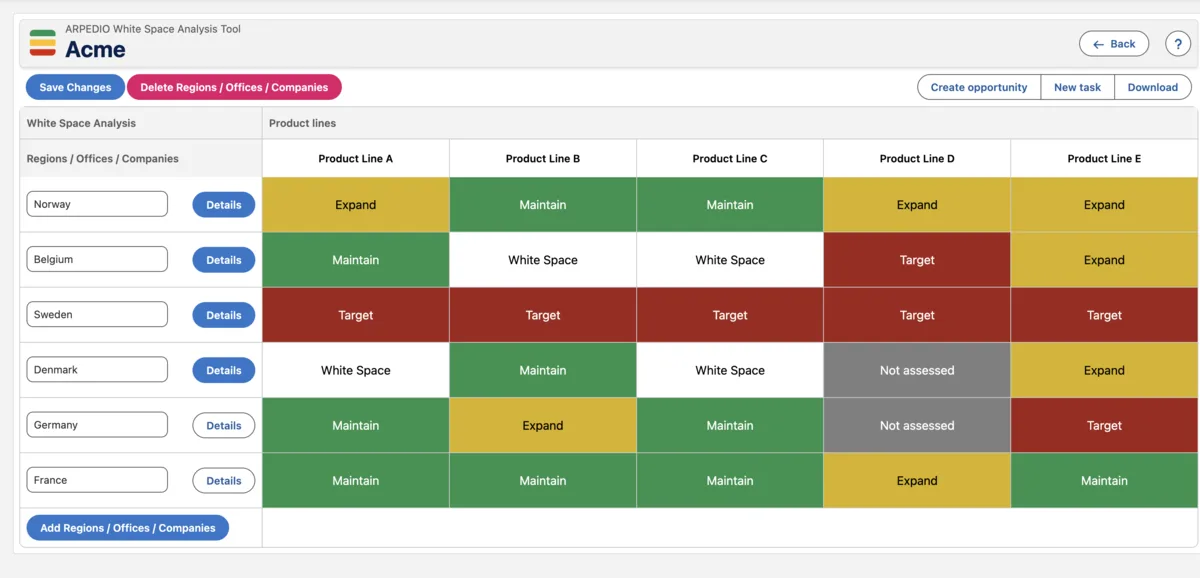
White space matrix in Salesforce — product lines (columns) across regions (rows), with each cell color-coded by state: Expand, Maintain, Target, or White space
A white space matrix configured per account: products across the columns, regions across the rows, each cell color-coded by state. ARPEDIO renders this as a Salesforce record so the data behind every cell is live.

The matrix is only as good as the data behind it. Cells need to be populated from real revenue records, real opportunity records, and real account intelligence — not from a quarterly guess. That's the operational reason teams move white space analysis out of spreadsheets and into Salesforce: the data already lives there.

Cell states

The four cell states: Expand, Maintain, Target, White space

Once the matrix is laid out, every cell falls into one of four states. The states matter because they tell you what to do — not just what's there.

Expand — existing revenue, room to grow

You've sold this product in this region; the customer uses it; there's signal that they could buy more — additional users, new modules, expanded scope. Action: a structured upsell motion, often led by Customer Success in partnership with the AE. Expand cells are usually the highest-yield, lowest-friction opportunities in the matrix.

Maintain — existing revenue, stable

You've sold this product in this region, the customer is fully deployed, and there's no realistic expansion in this cell. Action: protect the renewal, keep relationships warm, watch for change. Maintain cells aren't a source of new revenue — but they're a source of new risk if neglected.

Target — no revenue yet, active opportunity

You don't have revenue in this cell yet, but there's an active opportunity — a deal in pipeline, a stakeholder champion, a budget cycle in motion. Action: standard MEDDPICC-qualified deal management. Target cells are where white space converts to forecast.

White space — no revenue, no active opportunity

This is the cell that gives the practice its name. The customer has a buying center, a budget, and a need that maps to something you sell — but there's no opportunity yet, and possibly no relationship. Action: prospect the cell. Identify the buyer. Build the relationship. Move the cell from "white space" to "target."

The two states that get neglected are Maintain and White space. Maintain cells get neglected because nothing's broken; teams forget that a customer's buying center can churn even when the relationship feels stable. White space cells get neglected because they're harder — there's no champion, no inbound, no clear path. The teams that systematically prospect their white space cells are the teams that beat their expansion number.

Playbook

A practitioner playbook for running white space analysis

There's no single "right" cadence — but there is a sequence that works.

  1. Build the matrix per account, not per portfolio. It's tempting to build one matrix that spans every strategic account. Don't. The row dimensions vary too much across accounts; what makes sense for a regional retailer doesn't make sense for a global manufacturer. One matrix per account, configured to that account's structure.
  2. Populate from data, then talk to humans. Cells should be populated from CRM records first — opportunities, contracts, contacts, activity. Once the data view is in place, walk it with the account team. The data tells you where revenue is; the team tells you why a cell is empty (and whether the answer is "we tried and lost" or "we never tried").
  3. Triage the empty cells. Not every white space cell is worth chasing. For each, ask: is there a plausible buying center? Is the budget meaningful? Do we have a credible play? Mark each white space cell as Pursue, Park, or Pass. Most teams find 60–70% of their cells are Park or Pass — and that's fine. The point is to focus the Pursue cells.
  4. Assign cell ownership. Every Pursue cell needs a name on it — usually the account team member best-positioned to open that buying center. Without ownership, white space turns back into a spreadsheet that nobody updates.
  5. Review on a defined cadence. Quarterly reviews work for most accounts. Strategic accounts in fast-moving categories may warrant monthly. Annual reviews are too slow — buying centers shift inside that window.
  6. Tie cells to your account plan. White space analysis isn't a separate exercise — it's an input to the account plan. The Pursue cells become the expansion pipeline; the assigned owners become the action plan; the next review is the governance cadence.
From spreadsheet to system of record

Doing white space analysis in Salesforce

Most enterprise sales organizations run their first white space exercise in Excel. The first matrix gets built in a meeting. It's emailed around. Two weeks later, it's stale; six weeks later, nobody can find it.

The shift to running white space analysis inside Salesforce — as a structured object, not a screenshot pasted into the account plan — is what makes the discipline durable.

The matrix becomes a Salesforce record

Cells are populated from the same opportunity, contact, and contract data that already drives the rest of the CRM. When a deal moves stage, the cell updates. When a customer's structure changes, the matrix can be reconfigured without rebuilding from scratch.

Ownership is enforced by the platform

Every Pursue cell has an owner. Every cell has a next-action date. Every owner sees their cells on a dashboard. The account team meeting becomes a review of the matrix, not a hunt for the latest version.

It connects to the account plan

White space cells flow into account-plan goals, which flow into MEDDPICC-qualified opportunities, which flow into close. One data model, one source of truth — instead of three disconnected slide decks.

In ARPEDIO

ARPEDIO's account planning module runs white space analysis as a configurable matrix natively in Salesforce — with cell ownership, expected revenue per cell, and integration with the rest of the account plan and MEDDPICC-qualified opportunities. See how it works on the Account Planning page →

Common mistakes

Five patterns to avoid

1. Treating it as a one-time exercise

White space analysis is a cadence, not a deliverable. The matrix is wrong by Q+1 if you don't refresh it. The teams that get value run a structured review every 30, 60, or 90 days depending on account velocity — not when the next QBR forces them to.

2. Confusing white space with pipeline

Pipeline is what's in motion this quarter. White space is what isn't in motion but should be. Conflating them turns the matrix into a forecast — and the moment it's a forecast, it stops being a planning tool.

3. Building the matrix without account team buy-in

A matrix built by a single seller is a guess. A matrix built across the account team — AE, CS, SE, exec sponsor — is a plan. The act of building it together surfaces what each person knows that the others don't.

4. Picking the wrong rows

Defaulting to "regions" because that's how Salesforce reports are organized — even when the customer is centralized — produces a matrix that doesn't map to how decisions get made. Pick rows that mirror the customer's buying structure, even if that means each account in the portfolio looks different.

5. Measuring activity instead of cells closed

It's easier to measure "did we run the white space review" than "how many white space cells converted to Target this quarter." The activity metric is fine for adoption; the cell-conversion metric is what matters for outcomes.

A worked example

What 18 months of white space discipline looks like

A global industrial services company running a SAMA 7-step strategic account program at the time it adopted ARPEDIO. Strategic accounts were managed by a small SAM team; the rest of the customer base was reactive-transactional.

The first white space matrix the SAM team built — for one of their largest customers — was four products by six regions, populated from existing Salesforce data. Of the 24 cells, the team found:

The 12 white space cells got triaged into Pursue, Park, and Pass — five Pursue, four Park, three Pass. Each Pursue cell got an owner from the account team and a 90-day next-action plan.

Eighteen months later, three of the five Pursue cells had converted to Target. Two of those had become Expand cells (closed and growing). The matrix had been re-mapped twice as the customer reorganized, with the second remap surfacing two cells that didn't exist in the original matrix.

The Strategic Accounts Director's read at that point: the discipline didn't make any individual conversation easier. It made the next twelve conversations more deliberate. The lesson the team took away wasn't about the conversion rate. It was about the cadence — running the review every 90 days was what made the matrix a planning tool instead of a museum piece.

FAQ

Common questions

What is white space analysis?

White space analysis is the practice of identifying revenue opportunities inside accounts you already do business with — products you haven't sold them, business units you haven't reached, geographies you haven't entered, and buying centers you don't yet have a relationship with. It runs on a structured matrix that maps what the customer already buys against what they could plausibly buy, surfacing the gaps as either active opportunities (Target) or strategic prospects (White space).

What's the difference between white space and green space in sales?

White space and green space are often used interchangeably, but most enterprise sales teams use them with a slight distinction: white space refers to gaps inside accounts you already serve (existing customer, untapped product or buying center); green space refers to net-new accounts you don't serve at all. Some organizations also use "greenfield" to describe entirely new markets or industries. The boundary isn't standardized — define it the same way across your team and stay consistent.

Is "whitespace" the same as "white space" or "white-space"?

Yes, all three forms refer to the same concept. "White space" (two words) is the most common form in enterprise sales literature and is the canonical form in this guide; "whitespace" (one word) appears more often in product and marketing contexts; "white-space" (hyphenated) shows up in formal writing. Google treats all three as equivalent for search.

What's a white space matrix?

A white space matrix is a two-axis grid that maps what an enterprise account buys (or could buy) against where it buys (or could buy it). Columns are typically products or service lines; rows are typically regions, business units, or buying personas — chosen per account based on how that customer's buying decisions are structured. Each cell represents a single buying decision and gets one of four states: Expand, Maintain, Target, or White space.

What's a white space opportunity?

A white space opportunity is an unsold cell in the matrix where there's plausible buying potential but no active deal in pipeline yet. The cell has a real buyer, real budget, and a need that maps to your offering — but you don't have a relationship, a champion, or an opportunity record yet. Converting white space opportunities into Target cells (where there's an active deal) is the core motion of the discipline.

How do I do white space analysis in Salesforce?

You can build a white space matrix in any system, but Salesforce-native tools make it durable. The matrix is configured per account (columns from your product hierarchy; rows from regions, business units, or personas). Cells are populated from existing opportunity, contract, and contact data. Each cell gets an owner, a state (Expand / Maintain / Target / White space), and a next-action plan. ARPEDIO's account planning module runs this natively — the matrix is a Salesforce record, not a screenshot. See it on the Account Planning page →

What are white space accounts?

"White space accounts" usually refers to one of two things: accounts that contain a high proportion of white space cells (lots of unsold opportunity within an existing customer), or net-new accounts where you have no revenue at all (some teams use this term where others would say "green space" or "greenfield"). Define the term consistently within your team to avoid confusion.

How is white space different from upsell or cross-sell?

Upsell and cross-sell are sales motions; white space analysis is the diagnostic that identifies where upsell and cross-sell motions should be aimed. The matrix surfaces specific cells of opportunity (e.g., "Workflow Suite × APAC Operations") that an upsell or cross-sell motion can then go after. Without the matrix, upsell and cross-sell tend to follow whoever asks loudest; with the matrix, they follow the strategic priority.

How often should you run white space analysis?

Quarterly is the right cadence for most strategic accounts — long enough that buying centers can meaningfully change, short enough that the matrix doesn't go stale. Faster-moving accounts (rapid M&A, major reorganizations, new buying-center additions) may warrant monthly. Annual reviews are too slow; buying centers shift inside that window and the matrix is wrong by mid-year.

Can AI agents identify white space automatically?

For the data-population part of the work, increasingly yes. AI agents can scan opportunity records, contact patterns, and product usage signals to flag cells that have moved (or should move) between states. They can't replace the strategic triage — deciding which cells are Pursue, Park, or Pass still requires human judgment about budget, relationship strength, and competitive context. The most useful pattern is AI Agents handling the matrix-keeping work, with the account team owning the strategic decisions. Explore ARPEDIO's AI Agents →

Related

Keep going

See where the white space lives in your accounts.

A 5-minute walkthrough of ARPEDIO's white-space matrix running natively on Salesforce — no form, no setup.

Watch Demo Let's Talk