Account management keeps customers.

Key account management compounds them.

Definition

What is key account management?

Key account management (KAM) is the structured discipline of growing and retaining an enterprise's most strategically important customers. It allocates dedicated coverage, formal processes, and deeper resources to the accounts that represent a disproportionate share of current and future revenue — typically the top 10–20% of the customer base by strategic value.

KAM is distinct from general account management in three ways. It applies a formal account plan to each account — a structured document capturing the current situation, stakeholder network, growth opportunities, and action commitments. It builds and maintains a stakeholder map across the buying organization, tracking who holds influence, who has formal authority, and where the relationship currently stands. And it runs a disciplined review cadence — typically quarterly — where the KAM and account team assess progress against plan, requalify pipeline, and update the stakeholder picture.

Title conventions vary. In the United States, the role is often called "strategic account manager." In Europe, and especially across DACH markets, "key account manager" (KAM) dominates by a wide margin. SAMA — the Strategic Account Management Association, the professional body for the discipline — uses "strategic account management" as the canonical term, which is why you'll see both SAM and KAM used interchangeably throughout industry literature. This guide defaults to KAM, consistent with how most practitioners in enterprise B2B markets describe their role.

Why it matters

Why enterprises build a KAM function

KAM programs exist because the economics and operational realities of enterprise B2B revenue make shallow coverage of important customers expensive.

Revenue is concentrated in a small number of accounts

In most enterprise B2B businesses, the top 10–20% of accounts generate 60–80% of total revenue. Treating those accounts with the same coverage model used for the long tail — reactive, transactional, rep-dependent — leaves material revenue at risk and expansion opportunity uncaptured. The KAM function is the structural response: formal, programmatic coverage on the accounts where the math justifies depth.

Buying committees have grown beyond what one seller can hold

Enterprise buying decisions now involve an average of 6–10 stakeholders for mid-market deals and 20 or more for strategic accounts — across business units, functions, and geographies. A single seller managing those relationships from memory and a personal CRM contact list is not running a program; they're running a risk. When they leave, the relationship leaves with them.

Institutional knowledge disappears when people move

The most expensive problem in enterprise account management is invisible: a KAM leaves, taking two years of relationship context — which contacts are reliable, which deal is genuinely live, what the customer cares about at the executive level — with them. The incoming KAM starts from scratch. The accounts most at risk of churn are precisely the ones where the relationship was most personalized and least documented. KAM programs solve this by moving relationship intelligence from heads into structured, shared systems.

Comparison

KAM vs account management: what's the difference?

The terms are often used interchangeably, but there's a meaningful structural difference in what each role covers and how it's measured.

Account management: breadth-focused, retention-oriented

A general account manager typically carries a portfolio of 50–100+ accounts, with a primary mandate of retention and transactional renewal. Coverage is reactive: accounts surface through support tickets, renewal cycles, and inbound requests. There's no formal account plan, no structured stakeholder map — the relationship lives in the rep's memory and whatever CRM notes they keep.

Key account management: depth-focused, growth-oriented

A KAM carries a far smaller portfolio — typically 10–30 accounts — and runs a formal program in each. The mandate is long-term revenue growth, not just retention: identifying and closing expansion opportunities across business units, products, and geographies inside the existing footprint. Success is measured on net revenue retention and account growth rate, not transactional close rate.

The three-tier enterprise sales hierarchy

Mature enterprise sales organizations typically run three tiers of account coverage. General account management handles the long tail. KAM handles the top 10–20% of accounts by strategic value. Strategic account management (SAM) — sometimes called global account management — handles a handful of the largest, most complex global customers with the highest programmatic depth. ARPEDIO covers all three tiers: opportunity management for deal qualification, account planning for the KAM layer, and full strategic account management for the SAM tier — all running natively on Salesforce.

The discipline

The four disciplines that define a KAM program

A KAM program isn't a set of activities — it's a system. Four disciplines, running together, produce outcomes that neither discipline achieves alone.

1. Account segmentation

Not every customer deserves KAM-level coverage. Segmentation is the work of deciding which accounts belong in the program and which don't — based on current revenue, strategic potential, relationship depth, and competitive sensitivity. Segmentation done well is uncomfortable: it forces explicit prioritization and creates accountability for the accounts that don't make the cut. Most organizations run this annually, reviewed quarterly.

2. Account planning

The account plan is the central artifact of KAM. It captures the current situation in the account (business context, key initiatives, relationship status), the KAM's strategic objectives for the relationship, the mapped stakeholder network, the identified growth opportunities, and the specific commitments the team is making to advance them. An account plan that isn't maintained is a filing exercise; the discipline is in the update cadence, not the initial document.

3. Stakeholder mapping

Knowing who buys is not the same as knowing why they buy, what they care about, or how much influence they actually hold. Stakeholder mapping goes beyond org charts: it tracks relationship strength, sentiment, decision authority, and the connections between stakeholders — who influences whom, who is a blocker, who is a champion. The map is a live document, updated as people move, roles change, and relationships develop.

4. Review cadence

A quarterly business review (QBR) is the KAM program's governance mechanism. The KAM and the account team assess progress against the account plan: which opportunities advanced, which stakeholder relationships strengthened, where the plan needs updating. The review cadence enforces accountability and creates a rhythm of deliberate action on the accounts that matter most. Without it, account plans become annual rituals rather than living strategies.

Account planning

Account planning in practice: what a good plan contains

An account plan is only as useful as its update cadence. Teams that spend two days building a perfect plan and never look at it again have done expensive filing. Teams that build a good-enough plan and update it after every meaningful customer interaction have a living system.

The five components of a strong account plan

  1. Situation summary. The customer's current business context — industry position, strategic priorities, known challenges. Written from the customer's perspective, not the seller's.
  2. Relationship status. An honest assessment of where the relationship stands: which stakeholders are engaged, which are unreached, what the customer's perception of the relationship is.
  3. Opportunity map. The identified growth opportunities inside the account — by product, business unit, or geography — scored by size, readiness, and competitive risk. White space analysis is the specific technique for mapping uncaptured expansion opportunity.
  4. Stakeholder network. The mapped buying organization — names, roles, influence levels, relationship strength, and sentiment. Integrated with the account plan rather than held separately.
  5. Commitments. The specific actions the KAM and team are committing to in the next 30–90 days, with owners and dates. A plan without commitments is analysis; commitments are where the plan becomes a program.

The SAMA 7-step framework

SAMA — the Strategic Account Management Association — publishes the most widely adopted methodology for running a KAM program at depth. Its 7-step framework covers account selection, customer business understanding, joint value creation, stakeholder alignment, plan development, execution, and governance. Most mature enterprise KAM programs use the SAMA framework, or a version of it, as the structural backbone for both account plans and QBR cadence. ARPEDIO is a global technology partner of SAMA; the ARPEDIO–SAMA partnership operationalizes the framework inside Salesforce.

In ARPEDIO

ARPEDIO's account planning module puts the account plan — situation summary, opportunity map, stakeholder network, and action commitments — inside Salesforce as structured data, not a slide deck. Account plans update in real time as CRM data changes, opportunities progress, and stakeholders are added. Every plan is shared across the account team, so a rep transition doesn't reset the relationship. See the Account Planning & White Space product page for the full capability set.
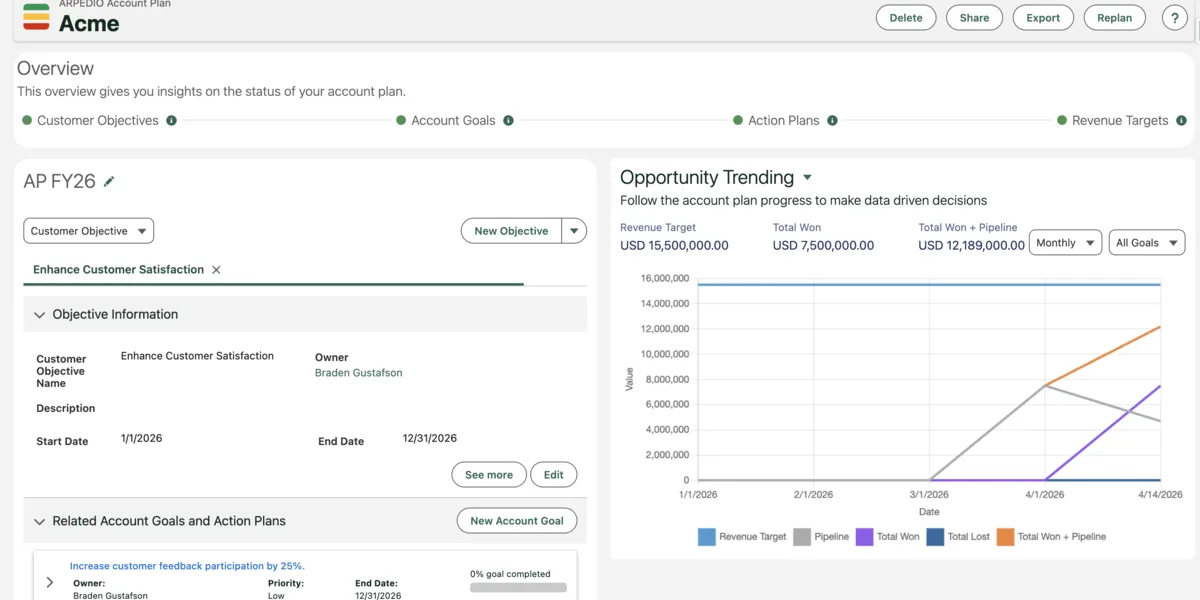
ARPEDIO strategic account plan in Salesforce — structured account plan view showing situation summary, stakeholder network, and opportunity map for an enterprise KAM.
ARPEDIO's account plan view in Salesforce. The plan lives in the CRM as structured data — shared across the account team, updated in real time, and accessible through a rep transition without data loss.
Stakeholder intelligence

Why stakeholder intelligence is the KAM practitioner's edge

The single most reliable predictor of KAM program performance isn't account plan quality or QBR frequency — it's stakeholder coverage depth. Teams that have mapped, active relationships with 60–70% of the relevant stakeholders in an account consistently outperform teams running single-threaded relationships through one or two contacts.

What stakeholder mapping captures

A stakeholder map goes beyond an org chart. It records relationship strength (how well does the KAM or team actually know this person?), relationship sentiment (is this contact an active champion, neutral, or a detractor?), formal decision authority (does this person hold budget, approval, or veto power?), and influence network (who does this person listen to, and who listens to them?). The map is dynamic: roles change, people move, sentiment shifts. A stakeholder map that was accurate six months ago may now be dangerously wrong.

The knowledge-loss problem

Airbus Defence & Space runs a KAM program across dozens of strategic defence accounts. Stakeholder relationships in that industry rotate on two-year cycles — programme managers, procurement leads, and technical contacts move regularly. Without a structured stakeholder map in the CRM, every rotation is effectively a relationship reset: the incoming KAM loses the context the departing one built. Structured stakeholder data in Salesforce changes the economics of rep transitions: the relationship isn't lost, it's transferred.

Relationship scoring and AI-assisted updates

Manual relationship updates — the KAM remembering to log a sentiment change after a call — are the weakest link in any stakeholder map. AI Agents built on Salesforce Agentforce can now read CRM activity data and surface relationship-health signals automatically: declining engagement frequency, sentiment drift in recent interactions, stakeholders who have gone dark. The KAM's judgment still owns the relationship; the AI handles the data work that too often doesn't happen at all. See how ARPEDIO's AI Agents approach this on Salesforce.

In ARPEDIO

ARPEDIO's relationship mapping module captures the full stakeholder network inside Salesforce — relationship strength, sentiment, influence connections, and org hierarchy — in a visual map that updates as CRM data changes. Individual relationship scores feed into account-level health indicators, giving KAMs and sales leadership a clear picture of where coverage is strong and where it's thin. See Relationship Mapping & Org Chart for the full capability set.

Tooling

Running KAM in Salesforce: why the CRM is the right home

Most KAM programs start in PowerPoint and spreadsheets. Most mature ones end up in Salesforce. The migration happens because the core problem with offline account plans is the same as the core problem with offline stakeholder maps: they don't update, they don't travel, and they don't survive rep transitions.

Native vs integrated — an architectural distinction

There's a meaningful difference between a tool that integrates with Salesforce and a tool that is built natively on Salesforce. An integrated tool syncs data from Salesforce into a separate application — so account plans, stakeholder maps, and opportunity scores live outside the CRM, requiring manual sync or API overhead, and creating a second system to maintain. A native tool builds all of that directly inside Salesforce: account plans live as Salesforce objects, stakeholder data lives on Contact and Account records, and AI Agents run on Salesforce's own Agentforce platform — so the data never leaves the instance and security and access controls are inherited from the CRM.

What a KAM platform adds to the CRM

Salesforce itself provides the system of record: accounts, contacts, activities, and opportunities. What it doesn't provide is the structured layer that makes that data useful for KAM — account plans with structured fields, stakeholder maps with relationship scoring, opportunity qualification frameworks like MEDDPICC, white space analysis across a portfolio, and the review cadence tooling that keeps all of it current. A KAM platform built on Salesforce adds that structured layer without duplicating the underlying data.

Salesforce Agentforce and AI in KAM

Salesforce's Agentforce platform introduces AI Agents that can act on CRM data inside the Salesforce environment. For KAM programs, the most immediate applications are relationship health monitoring (surfacing accounts where engagement is declining), account plan maintenance (auto-populating plan fields from activity and opportunity data), and next-best-action recommendations (suggesting which stakeholders to re-engage and when). The AI handles the data work; the KAM owns the relationship judgment and the customer conversation.

A worked example

What two years of structured KAM looks like in practice

A global industrial services company — operating across 35 countries, with over 40 named strategic accounts — recognized a familiar problem. Their KAM program existed on paper: account plans were written annually, presented in QBRs, and then left to rot in a shared drive. Stakeholder coverage was single-threaded in most accounts, with relationships held by individual reps rather than the account team. Two senior KAMs had left in eighteen months; both accounts they managed declined sharply in the following year.

The company adopted the SAMA 7-step framework as the structural backbone and moved account plans into Salesforce. The initial focus was narrow: pick the top 12 accounts by revenue, build account plans that the whole team could access and update, and run a structured QBR against each plan every quarter.

The first year was mostly discipline-building. Plans were updated inconsistently; QBR preparation took longer than expected because data was scattered. But by the end of year one, three things had changed:

By year two, the program had expanded to all 40 accounts. The lesson wasn't that structured KAM produces better outcomes — it was that the outcomes it produces are consistent, transferable, and compound. Individual KAMs varied in skill; the program removed the variance.

Common mistakes

Five patterns to avoid

1. Treating too many accounts as key accounts

The most common KAM program failure isn't bad account plans — it's scope inflation. When "key account" means the top 40% of the customer base, the dedicated coverage and programmatic depth that define KAM can't be delivered to any of them. Segmentation is a zero-sum decision: every account that gets KAM coverage is an account that pulls time from every other. Most enterprise KAM programs work best covering 10–20% of accounts by revenue and strategic value — the ones where the program's depth genuinely changes outcomes.

2. Building account plans that nobody maintains

An account plan written in January and reviewed in December isn't an account plan — it's an annual compliance exercise. The discipline is in the update cadence. Account plans that are touched after every significant customer interaction, reviewed in every QBR, and treated as live documents rather than static artifacts compound in value; plans that aren't maintained decay into fictions. The tooling choice matters here: a plan in a PowerPoint file is structurally harder to update than a plan in the CRM.

3. Mapping stakeholders without tracking sentiment

An org chart is not a stakeholder map. Knowing who holds which title tells you who can formally approve a decision; it doesn't tell you who will advocate for it, who is quietly opposed, or who influences the named decision-maker behind the scenes. Stakeholder maps that record only names and roles miss the relational intelligence that actually drives KAM outcomes. Sentiment — is this contact a champion, neutral, or a detractor? — and influence network are the fields that separate useful stakeholder maps from elaborate contact lists.

4. Running QBRs without a scoring mechanism

A QBR that reviews activity without assessing account health against a consistent framework produces conversations, not accountability. Teams that run QBRs without a scoring mechanism for relationship health, opportunity stage, and plan adherence lose the ability to compare accounts over time or across reps. Scoring doesn't have to be complex — a simple 1–5 scale on relationship depth, opportunity pipeline coverage, and plan currency is enough to surface which accounts are drifting and which are compounding.

5. Keeping KAM work outside Salesforce

Account plans in slide decks, stakeholder maps in personal spreadsheets, and relationship notes in email threads all share the same failure mode: they disappear when the KAM does. The structural case for running KAM inside Salesforce isn't efficiency — it's institutional durability. When the work lives in the CRM, it survives rep transitions, is visible to sales leadership, and can be acted on by AI Agents. When it lives in personal files, it is invisible, unscalable, and fragile.

FAQ

Common questions

What is key account management?

Key account management (KAM) is the structured discipline of growing and retaining an enterprise's most strategically important customers. It applies dedicated coverage, account planning, stakeholder mapping, and a formal review cadence to the accounts that represent a disproportionate share of current and future revenue — typically the top 10–20% of the customer base by strategic value. KAM is distinct from general account management in its depth, its programmatic approach, and the seniority of relationships it requires.

What is the difference between account management and key account management?

Account management covers a broad portfolio of customers with a focus on retention and transactional renewal. Key account management applies deeper, more structured coverage to a smaller set of high-value accounts — typically with a formal account plan, a mapped stakeholder network, and a quarterly review cadence. The difference is depth and resource allocation: a KAM carries fewer accounts (typically 10–30 versus 50–100 for a general AM) and is judged on long-term revenue growth inside those accounts, not quarterly transactional metrics.

What is a KAM in sales?

KAM stands for key account manager — a B2B sales role dedicated to the growth and retention of an enterprise's most important customer accounts. The KAM owns the relationship with each assigned account across the buying organization, runs an account plan, identifies expansion opportunities, and coordinates the internal resources needed to deliver value. The role is more senior and programmatic than a standard account manager, and is judged on multi-year revenue growth rather than transactional quarterly results.

How many accounts does a key account manager handle?

A key account manager typically handles between 10 and 30 accounts, depending on account complexity. At the strategic end — global enterprise accounts with large buying committees and multiple business units — a KAM may carry 3–10 accounts and run a full strategic account program in each. For mid-market key accounts with less complexity, a KAM might carry 20–30. The defining constraint is the depth of work required: account plans, stakeholder maps, QBR preparation, and expansion pipeline all take time per account.

What is a key account management plan?

A key account management plan (or account plan) is a structured document that captures the current situation in an account, the strategic objectives for the relationship, the stakeholder map across the buying organization, the identified growth opportunities, and the specific actions the KAM and internal team will take to advance them. Account plans are typically reviewed quarterly, updated after major customer interactions, and shared across the account team. In mature KAM programs, account plans live in the CRM — usually Salesforce — rather than in PowerPoint or spreadsheets.

What is the SAMA framework for account management?

SAMA — the Strategic Account Management Association — publishes the SAMA 7-step framework, the most widely adopted methodology for strategic account management. The seven steps cover: account selection and prioritization, understanding the customer's business, joint value creation, stakeholder alignment, account plan development, execution and measurement, and program governance. The framework is used by enterprise sales organizations globally as the structural backbone for SAM and KAM programs. ARPEDIO is a global technology partner of SAMA; the platform operationalizes the 7-step framework inside Salesforce.

What is key account management software?

Key account management software is tooling that structures and automates the core KAM disciplines inside a CRM: account plans, stakeholder maps, white space analysis, deal qualification (MEDDPICC), and review cadence. The best implementations are native to Salesforce — so account plans, stakeholder data, and opportunity scoring all live in the same system as the CRM data, with no manual syncing or data duplication. ARPEDIO is an account-based selling platform built natively on Salesforce that covers the full KAM discipline in one managed package.

What does account-based selling mean?

Account-based selling (ABS) is the sales-led discipline of structured, relationship-driven account execution — the counterpart to account-based marketing. Where ABM targets accounts with coordinated marketing campaigns, ABS equips the sales team with the intelligence, plans, and tooling to execute inside those accounts. KAM is the most structured form of ABS: a full account plan, a mapped stakeholder network, a qualified opportunity set, and a cadenced review process all directed at growing the relationship over time.

How do you measure key account management success?

Key account management success is typically measured across three dimensions: revenue metrics (net revenue retention, account growth rate, expansion revenue from existing accounts), relationship metrics (executive engagement depth, stakeholder coverage breadth, relationship health scores), and program metrics (account plan completion rate, QBR cadence adherence, opportunity pipeline coverage within key accounts). The most reliable leading indicator is stakeholder coverage — teams with deep, mapped relationships across a buying organization consistently outperform those relying on single-threaded relationships.

What is the difference between KAM and SAM?

KAM (key account management) and SAM (strategic account management) describe the same discipline with terminology that varies by geography and company. In the United States, SAM is the more common term — used by SAMA, the professional body. In Europe, particularly in DACH, KAM dominates by a significant margin (in Germany, KAM searches run roughly 300 times higher than SAM). Where companies use both terms simultaneously, strategic account manager typically refers to a senior role with a smaller, more complex portfolio, while key account manager may carry a larger set of accounts. In practice, treat the terms as interchangeable unless a specific role description or customer uses one consistently.

Related

Keep going

See how KAM practitioners run their accounts in Salesforce.

A 5-minute walkthrough of ARPEDIO's account planning, stakeholder mapping, and MEDDPICC scoring — running natively on Salesforce, no form required.

Watch Demo Let's Talk